

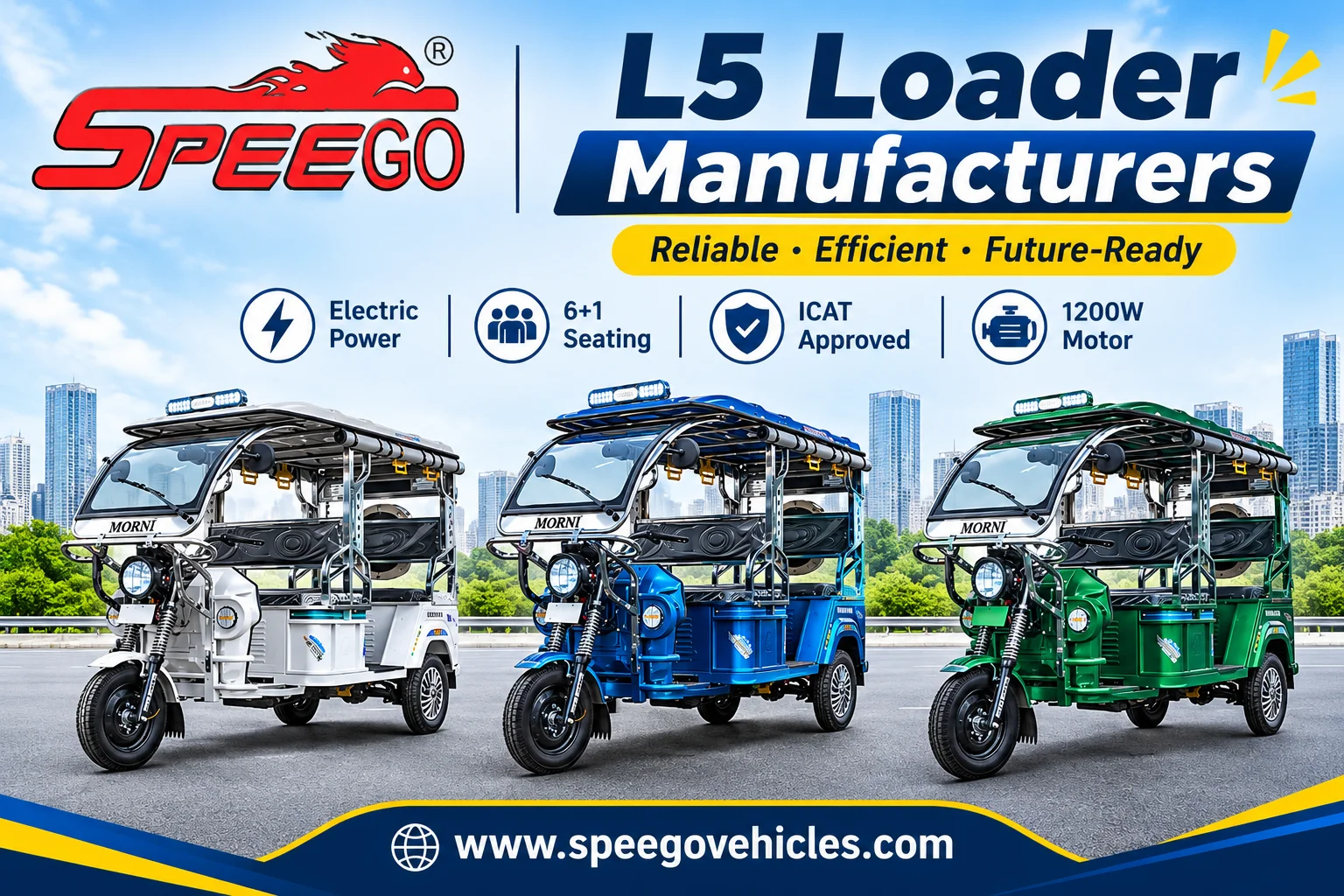
Electric rickshaws are now emerging as a viable solution for commercial transportation of people and goods. But with the availability of various types of e- rickshaw people are getting confused which one to choose such as L5 loader or L3 rickshaw. Choosing one among them depends on your vehicle requirements and the L3 or L5 loader manufacturers you choose to buy from. Understand the key difference between L5 and L3 to choose the one suitable for you.
Highest Speed
The speed of the vehicle matters the most. It helps you determine how faster you can run your vehicle and how quickly you can reach. L3 has the speed limited to 25 kilometers per hour, whereas L5 typically has around 45 to 70 kilometers per hour. So choose L3 for quick rides and L5 for longer routes to drive faster.
Capacity
Talking about the capacity of an electric rickshaw, you should know that knowing it can help you determine how much load or passengers you can carry in one go. L3 can carry up to 4 passengers excluding the driver and 40 kg of luggage, while L5 can carry around 15 people and 15000 kg of weight. Choose L3 for less passengers and weight and L5 for higher weightage and people.
Battery
Learning about the battery of your vehicle helps you understand how far your vehicle can run when fully charged and when you have to charge it. L3 usually has lead-acid or lithium-ion batteries, whereas L5 has lithium-ion batteries. Choosing a vehicle with a larger battery allows you to work a full shift without taking a break to charge up.
Motor Power
The motor of your electric vehicle directly affects its performance and repair costs. L3 has motor power limited to 2,000 watt and L5 usually has highest motor power between 6 KW to 12 KW range. For short trips, an L3 vehicle motor can provide good performance with low maintenance, but for long-distance routes, choose L5 with a high-power motor offering better performance, with usually high repair costs.
Suitability
L3 is suitable for short last-mile trips, narrow lanes, and metro station feeder routes, whereas L5 is better for longer city routes, arterial roads, and higher daily distances and loads. Choose the one according to your vehicle requirements.
| Features | L3 | L5 |
| Speed | 25 km/hr | 45 – 70 kkm/hr |
| Capacity | Up to 4 passengers excluding the driver and 40 kg of luggage | Approx. 15 people and 15000 kg of weight |
| Battery | Lead-acid or lithium-ion batteries | lithium-ion batteries |
| Motor Power | Up to 2,000 watts | 6 KW to 12 KW range |
| Suitable | short last-mile travels, narrow lanes, and metro station feeder routes | longer city pathways, arterial roads, and higher daily distances and loads |
Conclusion
Though both electric vehicles are better in their own ways. choosing one of them depends on how much distance your vehicle needs to cover, how many people or how much weight you want to carry, or how much you’re willing to invest in repair costs, etc. When you finally decide to buy one, make sure to choose a reliable manufacturer for quality and superior performance. This is where Speego Vehicles Co Pvt. Ltd. comes in. With years of experience, we are the best L3 and L5 Loader manufacturers who deliver high-quality products that meet customer demands in the domestic and overseas markets by ensuring innovation and sustainable growth.
FAQs
An electric vehicle with a motor power above 250 watts requires a valid driving licence officially issued by the RTO or the local transport department of your state.
An electric vehicle is much cheaper to run than petrol, diesel, or CNG vehicles, helping you save on running costs.
Choose reliable L3 and L5 loader manufacturers that offer after-sales service and ensure easier spare-parts availability.
Yes, electric vehicles are legally approved by the Ministry of Road Transport and Highways (MoRTH) and the Regional Transport Office (RTO).
When you go for a test drive, check acceleration, handling, steering, brakes, and gradeability (hill climbing).